Winter History & Heritage — #2 (December 12)
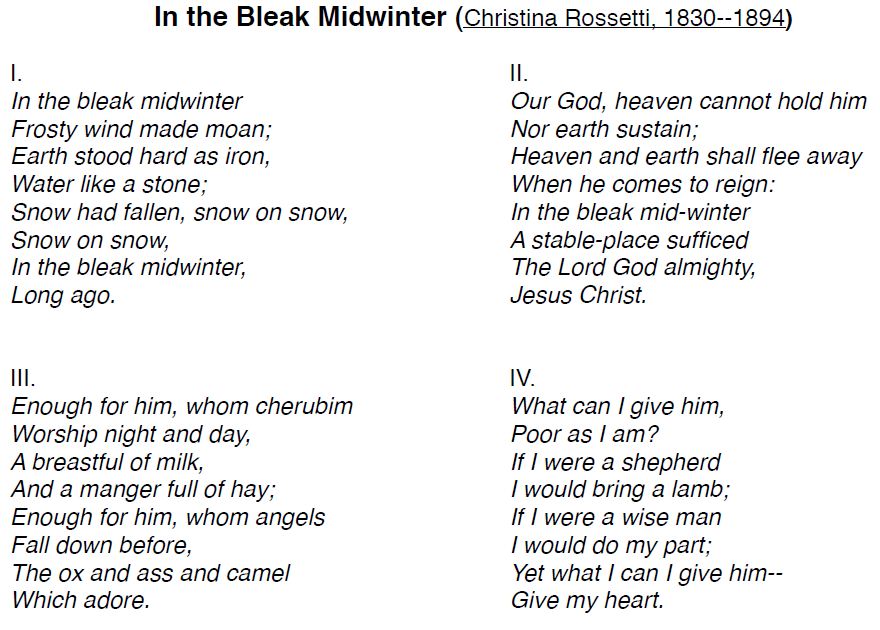
Our post this week includes a bit of Christmas verse (In the Bleak Midwinter) by Victorian poetess Christina Rossetti (1830–1894). Scroll to the bottom to view.
We try, for each season of the year, to commit a short but inspired passage to memory. In the fall we highlighted contemporary poet David Middletonʼs Of Magnanimity.
St. Nicholas — (Almanac, Dec. 6th)
This 4th-century AD bishop of Myra (an ancient city in southern Asia Minor, now Turkey) looms behind the popular and joyous legends of “Father Christmas” and “Santa Claus?” His piety and charity, not to mention his orthodox profession of faith, were without peer, giving rise to many myths trying to do justice to his sterling reputation. In Western art, he is often pictured with the three bags of gold he tossed through a destitute manʼs window to provide dowries for his daughters.
“a date which will live in infamy” — (Almanac, Dec. 8th)
Speaking solemnly to Congress, Franklin Roosevelt used this phrase to describe December 7, 1941, the day the U.S. naval base at Pearl Harbor, Hawaii, was “suddenly and deliberately attacked” by the Japanese? FDR called attention to Japanʼs “treachery” in having premeditated the attack for perhaps weeks, while seemingly engaged in sincere peace talks withAmerican officials. On December 8, by afternoon, Congress resoundingly issued a declaration of war.
Virginia Statute for Religious Liberty — (America, Vol.1, pp. 110-112)
Originally put forth by Thomas Jefferson in 1779, this religious rights bill failed to pass for a time, but was finally accepted by the Virginia legislature in 1786?The law, ably advanced by Madison while Jefferson represented U.S. interests in France, disestablished the Episcopal Church, granting equal status to all religions and equal religious rights to all citizens. As a result, neither church membership nor taxes in support of Episcopalianism could any longer be required in the Old Dominion.
Patrick Henry and Religion in the Old Dominion — (America, Vol.1, p. 111)
It may not have won the day in 1785, but Patrick Henryʼs bill to provide public support for “Teachers of the Christian Religion” was indeed a worthy alternative to Jeffersonʼs Virginia Statute for Religious Liberty (1786).
Under Henryʼs bill, teachers from a variety of Christian denominations (not just the Episcopalians or formerAnglicans) were eligible for state subsidy. Moreover, there were quite a few Virginians at the time, as author Bill Bennett noted, who saw in such a bill a great step forward in religious liberty and toleration
Jeffersonʼs proposal, in theory, took away any formal, communal affirmation of religion while establishing universal rights for all. Henryʼs, on the other hand, acknowledged publicly the essential Christian character of Virginia and Virginians, while securing a broad plurality of rights within the sphere of that general acknowledgement.
Ultimately, the question boils down to whether religious rights, to the extent they exist, are merely an individual or private matter, or whether there is not also some legitimate public and communal dimension to them. Is it desirable or even acceptable for a community, a social and political entity, to affirm its faith? Or, perhaps more troubling, to deny other faiths it deems too far removed from its own?
Henryʼs bill tried to balance the public with the private, the communal with the individual aspects of things in ways suited to his time and place. Is it necessary to point out that If your goal is both liberty and order, or ordered liberty, thatʼs a reasonable thing to do? Bennett made it sound as though the force of logic itself was clearly on Jeffersonʼs side, the side of universal private rights and public “wrongs” in religion. Is that so?This teacher remains unpersuaded (and he trusts he hasnʼt taken leave of his reason).
Click here to view a printable copy…